01
Product brief
THE PRODUCT IN ONE MINUTE
Professional access without the bottomless feed.
A voluntary LinkedIn session with two visible bounds: elapsed time and posts viewed. The product succeeds when people finish intentionally and remember what mattered.
People often need LinkedIn for job search, professional identity, and weak-tie maintenance. The same feed that provides that access is designed without a natural stopping point. For someone already managing attention regulation, the cost is not simply screen time. It is losing the original task.
Preserve familiar posts, reactions, and creator signals.
Recall, comprehension, intentional completion, settledness.
Diagnose attention, moralize use, or optimize engagement.
Design question
Can LinkedIn keep its professional utility while making the end of a visit visible from the start?02
Try it
CODED INTERACTION STUDY
Can one dock keep the resting screen quiet?
The embedded prototype is an Action Dock interaction study. It tests tap, drag, keyboard, and reaction feedback, not the full end-to-end product.
Try this: open reactions, choose Support, then move to the next post. Keyboard: 1 through 6 reacts, Arrow Up moves on, Arrow Right flips to the profile.
03
System anatomy
FRAME / MODULE / JOINT / TRACE
The finish line is product infrastructure.
The product has four modules: Bound the session, Focus the feed, Return chosen posts, and Close without scolding.
- 01 / BOUND
Choose time and post limits.
Five, 12, or 20 minutes map to eight, 15, or 25 posts. The first limit reached closes the session.
- 02 / FOCUS
Make one post the active module.
Progress, time, and the saved count stay visible. Secondary actions appear only after intent.
- 03 / RETURN
Let reactions seed future attention.
Insightful, Support, and Love place the post into a private fixed-interval queue. Like, Celebrate, and Funny remain ephemeral.
- 04 / CLOSE
End cleanly at either boundary.
A midpoint check-in appears once. Closure summarizes what happened and lets the person leave, review saved posts, or choose a new session.
TRACEAuthored prototype defaults
NOWD+3D+7D+14
The literature supports spacing as a general memory strategy. It does not validate this exact schedule for social posts or ADHD. The intervals are design defaults to test.
04
Key decisions
LOAD-BEARING CHOICES
Three decisions do most of the work.
Three decisions carry the concept: dual session bounds, an on-demand Action Dock, and reactions that make future attention explicit.
Two bounds, one actual stop.
Choice: expose time and post count together, then close at whichever arrives first.
Why: a timer alone can become another demand. A post bound makes the amount of content legible; a time bound prevents slow content from turning the session infinite.
Tradeoff: some sessions end before a person reaches a desired post. Starting another bounded session stays explicit.
One dock, closed by default.
Choice: collapse six reaction choices behind one 56px Action Dock trigger.
Why: reacting is the rare path. Six standing targets asked for a decision on every post before the person had read it.
Tradeoff: reactions take one more action. The common reading and move-on paths get a much quieter resting state.
Turn meaning into future attention.
Choice: reuse three semantically rich reactions as an explicit save-for-return action.
Why: the signal already exists at the moment something matters. The user sees the consequence before committing and can remove queued items.
Tradeoff: one reaction now has two meanings. Production copy, consent, retention, and queue controls are mandatory.
05
Evidence map
CLAIM ONLY WHAT THE ARTIFACT EARNS
Built, tested, synthetic, still open.
The repository proves interaction and implementation quality. It does not yet prove participant outcomes or platform viability.
Interaction study
Action Dock, gesture classifier, keyboard paths, reduced-motion behavior, focus management.
Product mechanics
Session reducer, deterministic scheduler, resurfacing queue, long-post reflow, React component.
End-to-end screens
Entry, setup, active session, midpoint, and closure screens. These are production-fidelity concepts, not integrated LinkedIn UI.
Measurement rehearsal
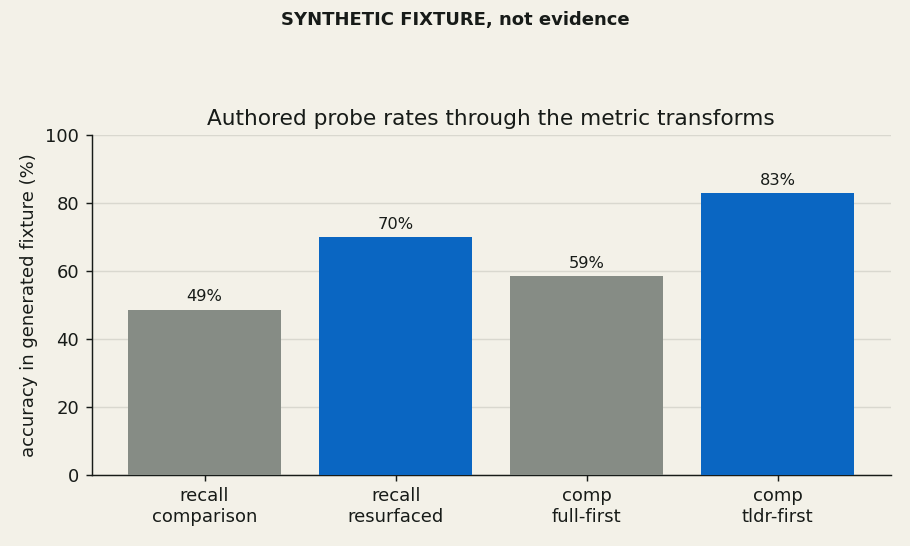
A fixed-seed event fixture exercises validation, transforms, and charts. Its apparent effects are authored and are not research results.
Human outcomes
No representative-user study yet. Recall, comprehension, settledness, and perceived control remain hypotheses.
Platform viability
No LinkedIn integration, privacy review, economic model, or production telemetry.
The coded artifact supports a design argument. It does not convert literature, synthetic fixtures, or implementation quality into evidence about people.
06
Option space
KILLED WITH REASONS
The quietest direction survived.
The permanent reaction tray, passive timer, and engagement-first success model were rejected because each weakened the core capability thesis.
Permanent reaction tray
Fast to discover, costly at rest. It placed six choices on every card, so the rare action dominated the common reading path.
Timer-only wellbeing mode
Easy to ship, too easy to ignore or experience as a scolding overlay. It changed the chrome, not the feed's stopping structure.
Time-on-app as the primary KPI
Simple for a dashboard, contradictory for the product. Engagement remains a business guardrail, never the success definition.
Bounded session + Action Dock
More system work, but one coherent model: visible limits, a quiet resting state, meaningful return, and explicit closure.
07
Research
LITERATURE-INFORMED, NOT USER-VALIDATED
Sources narrow the hypothesis.
The literature informs design hypotheses about delay, working-memory load, CDS, spacing, target acquisition, and choice. It does not validate this product.
| Source area | Narrow finding used | Design response | Confidence |
|---|---|---|---|
| ADHD delay aversion and self-regulation | Delayed outcomes and internally held goals can carry extra regulation cost. | Keep the boundary visible and make the next action external. | Literature-informed hypothesis |
| Cognitive Disengagement Syndrome | Research describes slowed or disengaged cognitive presentation; much of the cited work is pediatric. | Offer a lower-density Re-engage mode for future testing. | Adult generalization is open |
| Spacing and memory | Spacing supports memory across many learning contexts. | Prototype a private return queue. | Exact 3/7/14 schedule unvalidated |
| Fitts and Hick | Target acquisition and choice cost depend on size, distance, and option structure. | Use one large trigger and reveal six destinations on demand. | Interaction rationale, not outcome evidence |
References and scope notes
- Sonuga-Barke, E. J. S. (2002). Psychological heterogeneity in ADHD: a dual pathway model of behaviour and cognition.
- Barkley, R. A. ADHD and the Nature of Self-Control. The Guilford Press.
- Becker, S. P., et al. (2022). Consensus change in terminology to Cognitive Disengagement Syndrome. JAACAP.
- Mayes, S. D., et al. Neurocognition in children with Cognitive Disengagement Syndrome. Pediatric sample. PMC10474248.
- Ebbinghaus, H. (1885). Über das Gedächtnis.
- Adi-Japha, E., et al. (2017). Procedural memory consolidation in ADHD. PMC5540945.
- Fitts, P. M. (1954). The information capacity of the human motor system.
- Hick, W. E. (1952). On the rate of gain of information.
08
Evaluation
MEASUREMENT PLAN, NOT RESULTS
Test the riskiest assumption before the growth story.
A future study should test capability first, treat engagement only as a guardrail, and define harm thresholds before enrollment.
Did the session help?
- Resurfaced-content recall
- Comprehension after reflow
- Intentional completion
- Settledness change
Did platform value collapse?
- Opt-in and completion
- Reaction-mix change
- Resurface acceptance
- Task completion
Did the design make things worse?
- Compulsive re-entry
- Dismissal after resurfacing
- Worsened settledness
- Loss of perceived control
Proposed first study
Run a counterbalanced task study with representative participants before testing retention. Compare bounded and standard-feed conditions on equivalent professional tasks. Set exclusion rules, primary outcomes, analysis, harm thresholds, and stop conditions before enrollment. Follow with interviews about control, trust, reaction meaning, and closure.
09
Responsibility
PRIVATE ATTENTION NEEDS PRIVATE RULES
A private attention system has to behave like one.
A production version requires explicit consent, legible queue consequences, deletion and pause controls, data minimization, and accessible alternatives.
Tell people what a reaction will do.
The return consequence appears before commit. Participation is off by default and reversible.
Make the queue visible, editable, pausable, and deletable.
These controls are requirements for production, not features already implemented in the interaction study.
Store the minimum and define retention.
Do not train models on post text, reactions, attention patterns, or self-declared health context without separate informed consent.
Every gesture needs an equivalent control.
Tap and keyboard routes, visible focus, screen-reader names, reduced motion, and generous targets are part of the interaction contract.
AI boundary
Summarization or probe grading could be explored only after privacy review. Session bounds, reaction meaning, scheduling, queue ownership, and closure remain deterministic and user-controlled.10
Build + next
DESIGN ENGINEERING AS EVIDENCE
The implementation is part of the design argument.
The repository separates interaction, state, scheduling, reflow, React, tokens, and analytics so each claim can be inspected and tested independently.
STATEBounded session reducerMidpoint once, time cap, post cap, voluntary close
SCHEDULEDeterministic return logicReaction meaning and fixed intervals
REFLOWLong-post chunkingTL;DR-first paging rules
COMPONENTTyped React Action DockFocus, keyboard, and visual-order contract
SYSTEMGenerated design tokensLinkedIn product roles + Exposed Logic shell roles
MEASUREMENTExecutable rehearsalTyped events, fixed-seed fixture, transforms, charts
NEXT, IN ORDER
- Unify the Action Dock with the full bounded flow.
- Run manual VoiceOver, TalkBack, zoom, forced-colors, and switch-control checks.
- Test reaction meaning, perceived control, and closure with representative participants.
- Only then specify platform economics and a production data model.